The Role of Digitization in Open-Access Medical Literature
Many people, including those who have no ties to the medical industry, are curious about medical evolution over the years. Some people want to learn more about isolation protocols in ancient centuries, others are curious about the discovery of genes, and the list goes on. And with millions to billions of people relying on the same ancient literature to get their answers, a problem presents - just how can libraries give all these people access to the information they want without putting rare works at risk of wear and tear? Digitization with a touch of open access! Here's why and how it works.
The Why: The Open Access Angle
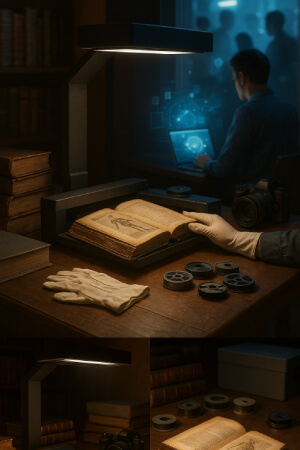
Before we get into how libraries and archives have managed to digitize their records, let's talk about why many of them offer open access to their records. So, what are open-access documents? If you have ever tried accessing an academic paper, you may have hit a paywall, where you were asked to pay a subscription fee in order to view the document - while this does not apply to all papers, it is quite common. Well, with open-access documents, such paywalls do not exist, and as such, these records are free to access for anyone online. And with that come the following perks:
- Equitable access. Providing the documents online for free removes the cost, time, and geographical barriers that exist in the world of research, especially for people in underserved regions. Think about it. Suppose you want to read a rare medical record kept in a university. You would have to make the trip to the institution, and that's assuming that you live close to the university and can access its library without a student card. But with open-access archives, you do not have to worry about where the actual document is housed. You can simply go online, find the digital version, and look for the information you want. And that means that researchers, students, and curious minds across the globe all have equitable access to these important materials.
- Faster scientific discoveries. The world of medicine features theories that were built atop others based on the strengths and weaknesses of the interventions that were in place. Physicians like Hippocrates built on the previous idea that disease was both physical and supernatural, and were able to prove that it was purely physical and due to internal imbalances. Then came others who were able to pick at these imbalances and find the root causes of different diseases, which is how we ended up with cellular theory, gene therapy, and more. It was discoveries like these that helped us deal with diseases like smallpox and cholera. But medical discoveries are far from over, and researchers still have a way to go in finding treatment options for diseases such as cancer and degenerative conditions. They need to pore through data to find patterns and perhaps figure out what else they can try. What's more, insights from previous centuries provide a basis on which researchers can come up with more effective ways of diagnosing and treating present-day ailments, as most life-saving drugs come with terrible side effects. So, with all this data available at the touch of a button, we get one step closer to medical breakthroughs.
- Provide data for trends. We now live in a world of advanced data analytics. That means that we are now able to analyze centuries' worth of data, which covers changes in medical concepts, diseases, and more. And by analyzing all this information, we can find patterns over the years, which can help us predict future trends in the medical space.
- Preservation for future generations. Rare literary works are quite fragile due to their age and the years of physical handling. As such, if we were to continue perusing them, one year after the other, it would only be a matter of time before they fell apart for good. In addition to this, physical book copies are subject to damage from external elements, such as floods, fires, and other disasters. With digitization, archives and libraries back up their works to the cloud, thus ensuring they are safe from these physical elements. They also go a step further in protecting these files with advanced encryption strategies to make sure that they are permanently available to those who need them.
- Enhancing public education. Let's be honest. People are intrigued by the world of medicine. They love understanding how their bodies function and what they can do to improve their health. There is also the undeniable fascination with diseases, which is why shows like House, New Amsterdam, and Grey's Anatomy are such hits. While they do have drama in the background, the focus is often on disease diagnosis and treatment, and people live for these shows. So, wouldn't it be nice if people had a platform where they could delve into the medical discoveries over the years? Open access medical literature ensures that everyone, regardless of medical knowledge, can learn more about the history and evolution of medicine, along with how it works. In so doing, we can all make more informed decisions when it comes to our health.
Journalists and policymakers are also great beneficiaries of these digital records, as they can use this data to inform their segments and policies. It is a win-win for everyone.
The How: Digitizing the Records
Given how fragile old medical literature is, the process of digitizing it is quite gentle. Below are the steps taken to make this possible:
Step 1: Scanning the Works
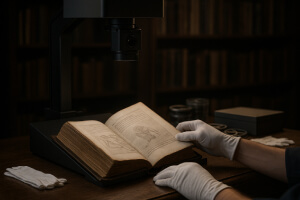
If you have ever scanned a document using a typical scanner, you probably think that the library staff lay the books flat on the scanner and go to work. But not quite. Since the older works are very fragile, doing so would damage their spines and bindings. So, libraries use overhead scanners coupled with high-resolution cameras to capture the writings and images. With this equipment, the staff can turn the books and images at safe angles that do not damage their bindings. And since they do touch the books when maneuvering them and turning the pages, they wear powder-free gloves to ensure they do not damage the books.
The scans not only capture the writings and images in the book in high quality, but they also capture the visuals of the book, such as the texture of the papers, the binding, and the annotations. This way, as you read the book online, you feel like you are turning the pages of the actual book, complete with its grayscale or black and white writing. Everything looks just like the original.
Step 2: Generating Searchable Text
Since the scans result in images, libraries and archives must then analyze the text in the images and convert it into searchable text, which is also readable by machines. To do this, they use optical character recognition software. If you often scan images on your phone, you may have come across this software, which is pretty easy to use. All you do is upload the image, and the software analyzes its text and presents it to you.
But while this may be easy with modern books, character recognition is a bit of a hit-and-miss when it comes to older materials. After all, they present challenges such as different or unusual spellings, irregular fonts, faded ink and low paper quality. For this reason, the library staff must go through the generated text and compare it with what is on the image. Where there are errors, they must manually correct these mistakes to ensure that the full text is accurate and searchable. As you would imagine, this takes quite a lot of time.
Step 3: Creating Metadata
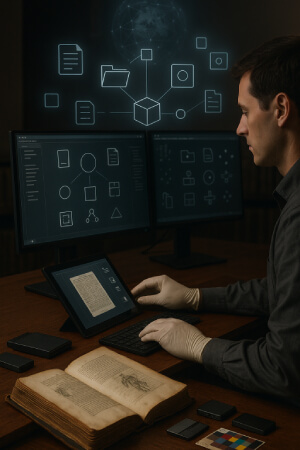
In the past, many valuable documents slipped through the cracks because they were not easily discoverable. But with a combination of rich metadata and full texts, libraries and archives can make sure that more people are able to find these hidden gems. The first step to ensuring this is by organizing all their data, which they do through metadata, which is essentially data about the data. This metadata can take various forms as follows:
- Descriptions. This type of data provides descriptive information about the book, such as its title, when it was published, its author, and language. For example, if a book is called ABC Medicine, the description would include this name so that anyone looking for that specific book would find it by entering its name. This metadata also serves searches across search engines, where someone entering related information will automatically find the book in the search results.
- Technical data. Each digital file is different from the other because of variations in file formats, resolution, etc. As such, libraries and archives categorize their works based on these specs. For example, you will find that most open-access documents are in the form of JPEG and PDF. The goal here is to inform the audience of the file formats so they can choose those which are compatible with the software on their devices. So, in the case of a reader whose phone can open PDF files, choosing the PDF format will suit them.
- Structure. Some readers love knowing where the chapters begin and how many files make up the book. This information is also made available through the metadata so that people can know exactly what they are accessing or downloading.
Additionally, libraries and archives include data on how other users can maintain the digital files over the years, thus making sure that the information remains available across future generations, even with the changes in technology.
Step 4: Hosting the Files
The final step is making the data available to users online, which libraries and archives do through their digital platforms, such as online libraries. Some do not require registration, while some require some information about you before allowing you access to their collections. But whichever the case may be, most of the platforms offer free access to their records. All you need to do is use the search button where you enter the name, author, and date of the book you would like to access. If you are not sure of these details, you can always use the advanced search function, which allows you to find books based on phrases or words. And now, with many of these libraries and archives integrating artificial intelligence (AI), you can seek help from an AI bot to narrow down your options.
“Let food be thy medicine and medicine be thy food.” – Hippocrates
— AncestralHealth☀️ (@AncestralHealtx) November 27, 2025
We took this wisdom, ignored it, and replaced real food with seed oils, sugary junk and pills for every symptom. Your grandparents understood this better than most doctors today: fix your food, and half your… pic.twitter.com/mcGdcHFTRi